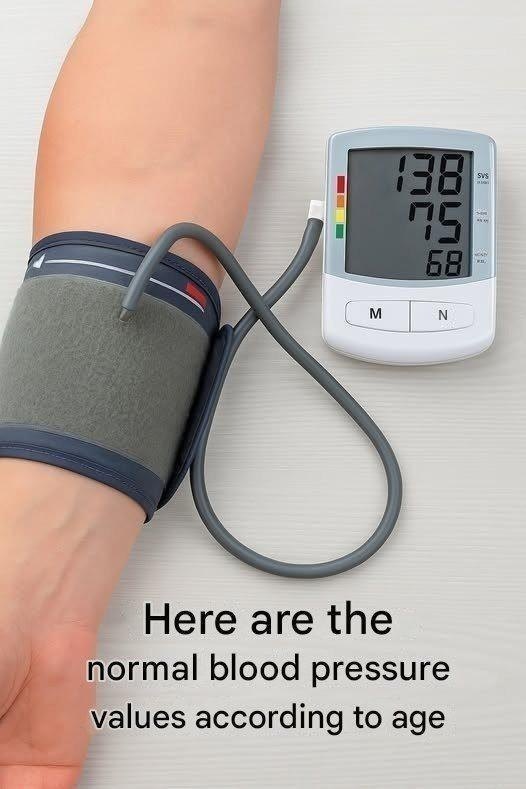
“Normal blood pressure” doesn’t change sharply by age, but typical healthy targets are mostly the same for adults, while children have age-based ranges.
Blood pressure is written as:
- Systolic (top number): pressure when heart beats
- Diastolic (bottom number): pressure when heart rests
🧑⚕️ Normal blood pressure by age
👶 Children (approximate ranges)
Children’s BP varies a lot with age, height, and sex, but these are general ranges:
| Age | Normal BP range (approx.) |
|---|---|
| Newborn (0–1 month) | ~60–90 / 20–60 |
| Infant (1–12 months) | ~80–100 / 50–65 |
| Toddler (1–5 years) | ~90–105 / 55–70 |
| Child (6–12 years) | ~95–110 / 60–75 |
| Teen (13–17 years) | ~105–120 / 65–80 |
🧑 Adults (18+ years)
For adults, guidelines are mostly consistent regardless of age:
✅ Normal
- Less than 120 / 80 mmHg
⚠️ Elevated
- 120–129 / less than 80
🚨 High blood pressure (Hypertension)
- Stage 1: 130–139 / 80–89
- Stage 2: ≥140 / ≥90
🆘 Low blood pressure (Hypotension)
- Usually below 90 / 60 (only a problem if symptoms occur like dizziness or fainting)
👵 Older adults
- Doctors still use the same general adult targets.
- However, in some elderly people, slightly higher systolic BP (up to ~130–139) may be accepted depending on health condition.
💡 Key takeaway
- Ideal adult BP: ~120/80 mmHg
- No strict “age-based normal” for adults
- Children’s BP depends strongly on growth and development
If you want, I can also tell you:
- What BP is dangerous in emergencies
- How to lower high blood pressure naturally
- How to correctly measure BP at home
