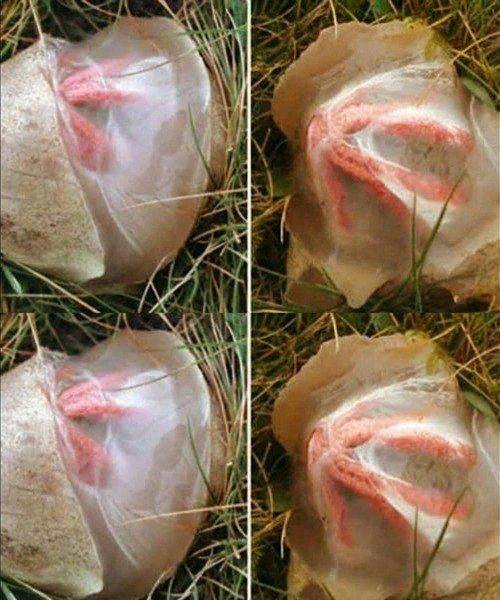
Puffballs are often called one of the “Foolproof Four” for beginner foragers because they don’t have gills, but they have some deadly lookalikes that you must know about before you ever consider them food.
The Main Difference: Gills vs. Gleba
-
Standard Mushrooms: Most have a cap, a stem, and gills (thin ridges) or pores (tiny holes) underneath the cap where they drop their spores.
-
Puffball Mushrooms: They have no cap or gills. They are essentially a solid ball of “gleba” (spore-bearing tissue). They “puff” their spores out of a hole in the top or when they burst.
How to Identify a True (Edible) Puffball
To be considered a safe, edible puffball, the specimen must pass The Internal Check.
-
The Color Test: Cut the puffball in half vertically. The inside must be pure, solid, marshmallow-white. * If it is yellow, green, or brown, it is “going to seed” (developing spores). At this stage, it will taste bitter and can cause severe stomach upset.
-
The Texture Test: It should have the consistency of a dense marshmallow or fresh mozzarella.
-
The Homogeneity Test: The inside must be perfectly uniform. If you see the faint outline of a miniature mushroom (a tiny cap and stem) inside the ball, do not eat it. This is an “Amanita Egg.”
Dangerous Lookalikes (The “Shouldn’ts”)
Since we started this chat talking about things you shouldn’t do, here is the most important rule in foraging: Never eat a round mushroom without cutting it open first.
| Lookalike | Why it’s dangerous | How to tell it apart |
| Amanita Egg | Contains Amatoxins; can cause fatal liver failure. | When cut open, you will see a tiny “baby” mushroom (cap/gills) inside. |
| Earthball (Scleroderma) | Toxic; causes severe vomiting and cramping. | The skin is thick and “warty” like a potato. The inside is black or purple, even when young. |
| Pigskin Poison Puffball | Causes severe gastrointestinal distress. | Harder to the touch than a true puffball; interior is dark/rubbery. |
Varieties You Might See
-
Giant Puffball (Calvatia gigantea): These can grow to the size of a soccer ball (or larger!). These are the safest for beginners because nothing else grows that big and round.
-
Common/Gem-studded Puffball: Smaller, about the size of a golf ball, covered in tiny “jewel” bumps that rub off.
-
Pear-shaped Puffball: The only common one that grows on rotting wood rather than the ground.
Would you like me to generate an image showing the difference between a true puffball and a dangerous “Amanita egg” so you know exactly what to look for?
