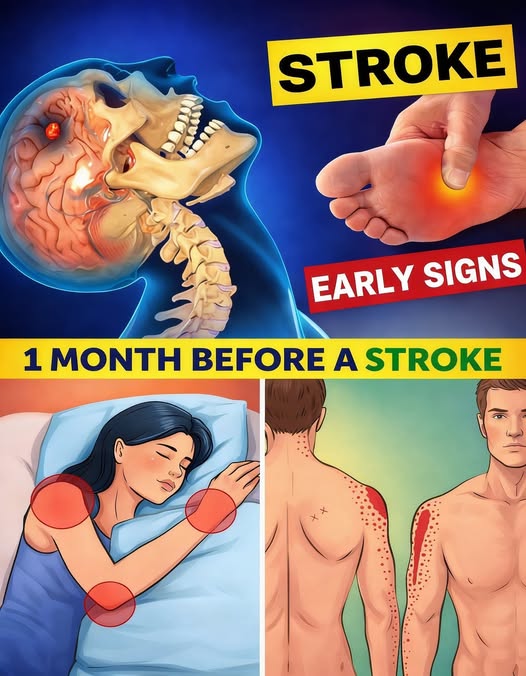
A key point first: a stroke usually does not give a clear, predictable warning 1 month in advance. Most strokes happen suddenly. However, some people do experience warning signs days to weeks before, usually due to a mini-stroke (TIA) or worsening blood vessel disease.
Here’s what medicine actually recognizes:
⚠️ 1. Mini-stroke (TIA) — the most important warning
A Transient Ischemic Attack (TIA) is often called a “mini-stroke.” It can happen days, weeks, or sometimes months before a major stroke.
Symptoms (sudden, temporary):
- Weakness or numbness on one side of the body
- Slurred speech or trouble understanding speech
- Temporary vision loss (one eye or blurred vision)
- Dizziness or loss of balance
- Face drooping
👉 Even if it lasts 5–30 minutes and disappears, it is a medical emergency warning sign.
⚠️ 2. Subtle early warning signs (weeks before in some people)
Not everyone has these, but they can happen:
- Repeated mild dizziness or imbalance
- Unusual fatigue or weakness
- Mild memory or confusion changes
- Headaches that are new or unusual
- Brief tingling or numbness episodes
👉 These are not specific, but in high-risk people they matter.
⚠️ 3. High-risk warning conditions (not symptoms, but signals of danger)
These increase stroke risk significantly in the following weeks/months:
- High blood pressure (most important risk factor)
- Irregular heartbeat (atrial fibrillation)
- Diabetes (poor control)
- High cholesterol
- Smoking
- Previous TIA or stroke
- Carotid artery blockage
🚨 4. FAST signs (actual stroke symptoms — emergency)
If stroke happens, symptoms are sudden:
F – Face drooping
A – Arm weakness
S – Speech difficulty
T – Time to call emergency help immediately
Important truth
There is no reliable “1 month early symptom list” for stroke.
But:
- A TIA is the strongest real warning sign
- Many strokes come with no warning at all
When to take action
Seek urgent medical care if:
- Any sudden weakness, speech trouble, or vision change occurs—even if it goes away
- You suspect a TIA
- You have multiple risk factors and new unusual neurological symptoms
If you want, I can explain how to reduce stroke risk after 60 in simple steps, or how to tell the difference between stroke vs. other harmless dizziness causes.
